
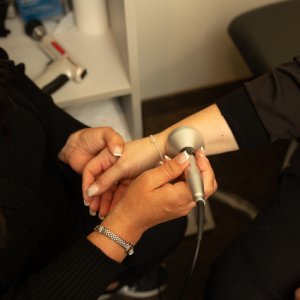
Most laser therapy research used devices under 0.5 watts. The study that changed my perspective used 10 watts.
That power difference isn’t just technical. It’s the difference between legitimate treatment and another supposed therapy that claims to do everything but delivers nothing.
I’ve seen too many treatments come and go. Class IV laser has proven itself time and time again as one of the premier treatment options for musculoskeletal conditions. The power makes all the difference.
Deeper Penetration, Real Healing
Higher power means deeper tissue penetration. When that 10W laser reaches tissues the weaker devices couldn’t touch, something fundamental happens at the cellular level.
Cells deeper in the tissues get stimulated. More blood supply. More oxygen. Actual healing begins.
But here’s what most people miss. This isn’t just about reducing inflammation. Class IV laser stimulates cells responsible for collagen formation. The mechanism involves photons dissociating inhibitory nitric oxide from enzymes, leading to increased ATP production.
Real tissue healing. Not symptom management.
The Cortisone Problem
When colleagues say “I’ll just give them a cortisone shot,” I explain why stimulating collagen formation beats temporary inflammation reduction.
Cortisone only reduces inflammation. Worse, it actually wastes tissue in the long run where the injection site is.
One or two injections spread apart won’t do much tissue damage. But repeated cortisone shots necrose tissue in the area. They weaken the joint and make everything worse overall.
I’ve seen patients with numerous cortisone injections over the years. The joint degeneration is horrible. Research confirms that cortisone injection into tendon tissue leads to cell death and tendon atrophy.
Class IV laser reduces inflammation and stimulates actual tissue healing. The choice seems obvious.
Patient Conversations That Matter
Most patients want quick fixes. They’ve been dealing with tennis elbow pain and want relief tomorrow, not in 18 days or 12 months.
I’m typically very upfront with them. I tell them the facts about getting cortisone and the facts about getting class IV laser. Then it’s their decision.
The tennis elbow study showed remarkable results. Handgrip strength improved by 17%, 52%, and 66% at 3, 6, and 12 months respectively. Pain with resistance was reduced by 50%, 93%, and 100% over the follow-up period.
What really makes patients commit is the long-term benefit. Complete pain elimination at 12 months. Not management. Elimination.
You should stay away from steroid injections if possible. Look to modalities like class IV laser for actual healing. It may take a little longer, but it’s worth it in the long run.
Professional Barriers
The biggest barrier preventing other clinicians from adopting high-power class IV laser therapy is investment cost. A class IV laser costs much more than a low power laser.
My philosophy was always if it got better results, I’m willing to make the investment.
Beyond the financial barrier, there’s a knowledge gap. All of the medical profession needs to recognize and get on board with this technology. It needs more recognition by everybody out there.
There’s a lot of products and confusion regarding treatment options for chronic conditions. The evidence base for class IV laser therapy keeps growing, but adoption remains slow.
The Future of Musculoskeletal Medicine
If high-power laser therapy becomes as established as research suggests it should be, chronic knee problems are next. Meniscus problems. Degenerative joint disease of the knees. Chronic hip problems.
I’m very confident it can help with knee problems because I’ve been treating many degenerative knee problems and meniscus problems with class IV laser already. I’ve seen the results.
People are avoiding surgery. Not all of them, of course, but I would say the majority are.
These are conditions where patients are often told surgery is their only real option. High-power laser could change those surgical conversations completely.
What would that mean for how we practice musculoskeletal medicine? We’d move from symptom management to actual tissue healing as the standard of care. We’d offer patients real resolution instead of temporary relief.
The power difference that started this revolution isn’t just about watts. It’s about changing how we think about healing itself.